
A Short Story
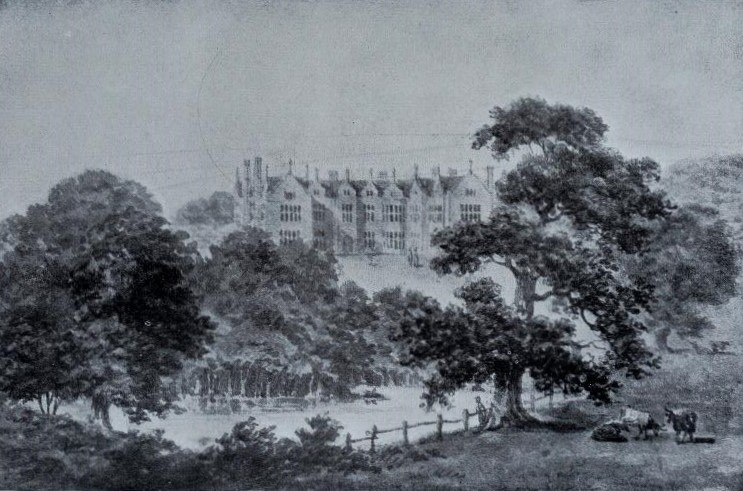
The marriage ceremony of my old friends Robert and Emma took place on the twelfth of June. The venue was Wakehurst Place, a perfectly maintained sixteenth-century mansion which sits proudly upon one of the highest elevations of the Sussex Weald. The house itself looms tall in the traditional gothic fashion, with dark brickwork set between slanted windows and crenellations running along the roof. Surrounding the house can be found over five hundred acres of woodlands and gardens, lonely save for the regular stream of visitors during the summer months. Four centuries had passed since Sir Edward Culpeper first constructed the mansion, and two decades had passed since the last Lord Wakehurst departed, bequeathing his home to the nation in perpetuity.
The morning and early afternoon passed by pleasantly enough. As a groomsman, my first real task of the day was to usher the guests into a small chamber for the exchanging of vows and the signing ceremony. Neither the groom nor bride were particularly religious, I would say. Yet, I was struck by the strong sense of Christian antiquity in the place, creating a marriage between the old world and the new. The guests sat in rows that imitated a church, surrounded by large oil paintings along every wall. The paintings depicted various religious scenes, typically showing lowly individuals staring up at saintly figures with pious expressions of adoration and wonder. I had cause to remember their faces for a long time to come. The paint was faded and chipped, often warped beyond clear recognition. Meanwhile, looming down from the wooden beams above were several, almost lurid interpretations of the crucifixion.
As we sat down to lunch, a growing heat could be felt in the air, leading to many loosened waistcoats and makeshift fans being utilised by the guests. The discomfort was increased by the old sash windows, which refused to open more than several inches, forcing us to make do with the limited ventilation.
While searching for a glass of water, I was accosted by the photographer. Could I help him clear the guests from the adjoining room, so they could keep it clear for the photos? The band would also like to come in and set up their instruments.
I would try my best, I said.
Most who had trickled out into the next room understood well enough. Following a few grumbles about catching some air and escaping the heat, they were happy to resume their seats and wait for the speeches to begin—all but one.
The old lady was, I believe, some distant aunt or cousin on the bride’s side. Yet, there was something disconcerting about her. I politely asked her to leave but found myself ignored. There I was, standing foolishly until she finally deigned to acknowledge me.
‘Ah,’ she said, in perceived distraction, ‘have you come bearing answers?’
I was nonplussed. ‘Answers? I am not sure what you mean. I have been asked if you wouldn’t mind—’
‘That photographer already asked,’ she interrupted with a snap. ‘I will move on when I am finished looking.’
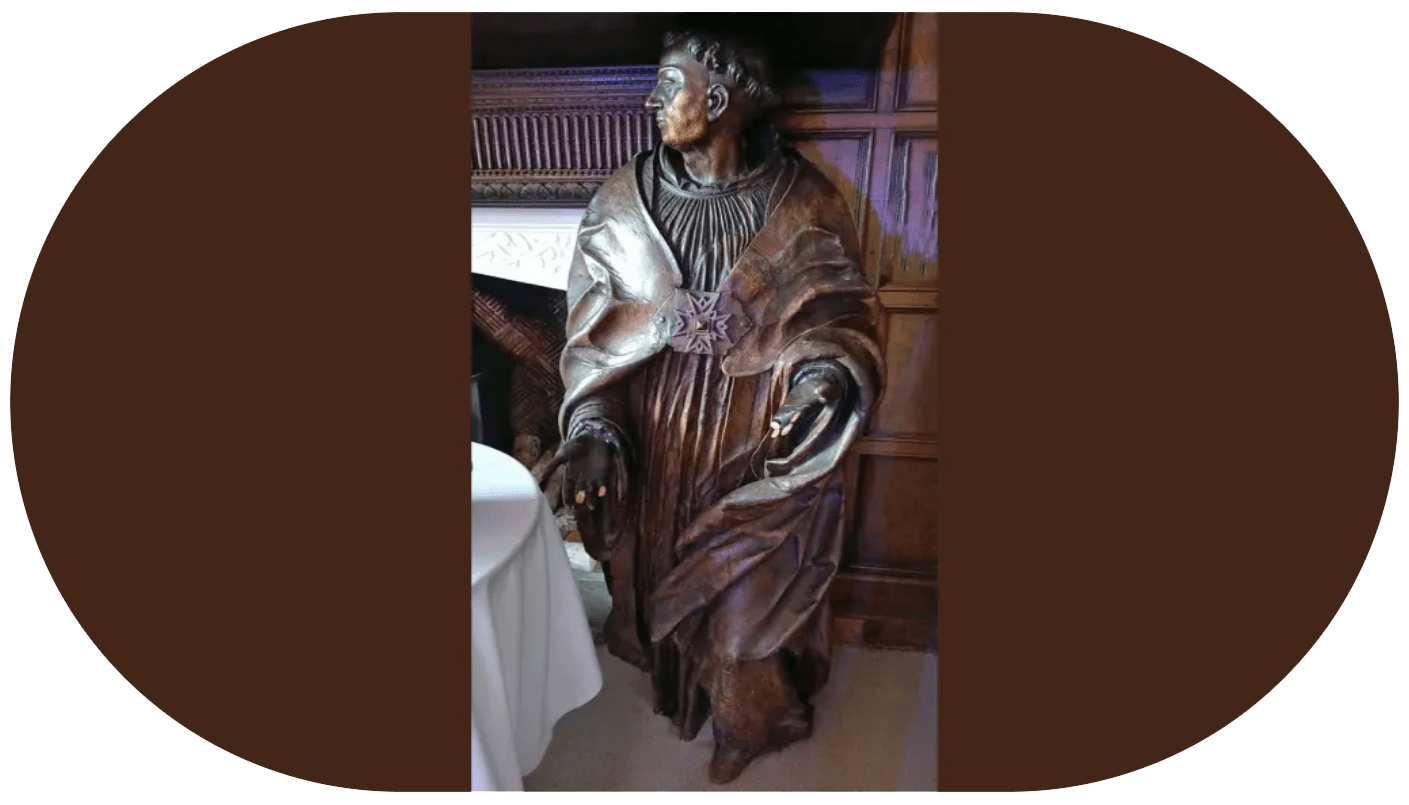
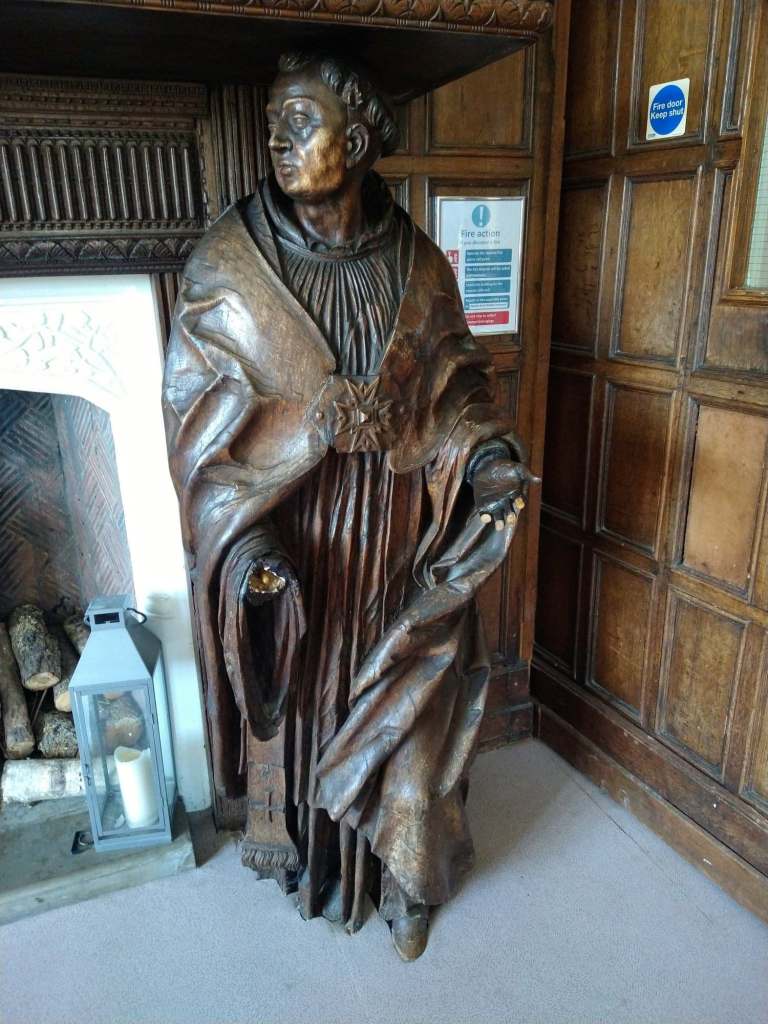
At this point, I noticed what she was examining in such detail. Supporting the mantelpiece were two life-sized wooden priests decked out in medieval gowns. They wore bland expressions on their young faces, staring out across the room towards the windows. I was puzzled by the placement of such detailed carvings, as the rest of the room was relatively plain and empty.
‘Made from black walnut,’ the lady said. She appeared to be an expert on the subject, at any rate. ‘But just look at the hands on this one! What is the story there, I wonder? See them all hacked away like that…’
She was not wrong. Someone—or something—had cut off most of the priest’s fingers, exposing several stumps in an apparent act of vandalism. It quite spoiled the work and left one wondering whether it was intentional.
‘Most likely, they snapped off by accident,’ I observed. ‘They must be forever moving tables in and out of the room.’
‘Too dull, too dull,’ said the lady, almost in exasperation. ‘Much more exciting if it were some vengeful act, no?’
My eyes darted towards the main reception, where I could already see the best man reading through the notes for his speech.
‘Who would want to do something like that?’ I said, trying to hide my growing impatience.
‘Could be anyone. A disgruntled servant in the past. Or the woodcarver, having not received their fair pay.’
‘I am sure it was an accident,’ I said again.
‘If you say so,’ she muttered. Then, almost as an afterthought, she added, ‘it could have been a vicious spirit of the house.’
‘What do you mean by that?’
She did not hear my question—she had turned back to the statue, speaking almost to herself. ‘A poltergeist. Yes, they are known to do that. There was that neighbour who lost their best plates that way…’
On any other occasion, I might have chosen to humour the old lady, but I confess the heat and general stress of the day had gotten to me. As my head thumped unpleasantly, I wanted nothing more than to sit down.
‘I do not believe in such things,’ I said. ‘Now, perhaps we better leave our friends, the priests, in peace for a while.’
The old woman raised an eyebrow and shot me a look. ‘Don’t believe in such things, eh? Who are you anyway?’ she asked, almost accusingly. ‘What do you do?’
‘I am a friend of the groom. As for what I do, though it is no one’s business, I am a lecturer in Mathematics and Computer Sciences.’
The old lady rolled her eyes. Under her breath, I heard her muttering something that sounded like a rational man.
I decided it would be best to leave the lady to her wild musings until she eventually moved on of her own volition. Turning away, I caught the eyes of the fingerless priest. There was something uncanny in that face, with its exaggerated features already seeming more real than when I first laid eyes on them.
Enough, I told myself. You are letting yourself get worked up.
It is at this point I should reveal my affliction. I have, at several times in my life, found myself plagued by fits of anxiety and mild paranoia, prone to rise at the worst moments. It is difficult to master one’s mind in such circumstances. Instead, I find myself at its mercy until the demon passes.
‘Are you all right?’ asked a friend as I resumed my seat at the table.
‘Y-yes,’ I stammered. ‘Except for that silly old woman over—’
I pointed through the wide archway into the next room, then stopped. She was nowhere to be seen. Only the fingerless priest stood against the wall, staring in my direction. Curious. I could have sworn its head was facing further to the right before.
‘Old woman?’ my friend inquired.
‘Oh… nothing,’ I said hazily. ‘Look, here comes dessert.’
*
I was determined to forget all about the encounter as the speeches began, though as I tried to pretend otherwise, I knew my affliction was coming on worse than ever. I could usually train myself to ignore it, a technique born of many years of struggle. Today, my sense of control faded completely.
It started in the body, in pulsing waves of dread and fear. All around, the large open space and crowd of silent observers became strange and unpleasant, even though all logic dictated otherwise. I hung on the outskirts of consciousness, unable to stare at one place for too long for fear of plunging into a dangerous mist. A ringing grew in my ears, joined by something else—an imperceptible crowd of voices somewhere in my mind.
I used to think I was insane until the day the doctor reassured me otherwise.
It is a form of tinnitus mixed with acute anxiety. The mind is a powerful tool—you can learn to control it.
Why today, of all days? I could no longer contain my frustration at the injustice of it all. Such rising anger inevitably worsens the symptoms, like tossing more wood on an already raging fire.
Concentrate, just concentrate on the speech.
The more I tried to focus on the best man and his words, the more aware of the symptoms I became. I could not ignore them or pretend they were not happening. I had to leave. Fresh air taken in deep breaths, with several large, cold glasses of water, would hold off the attack. For that was what I knew was coming, the worst sort of panic attack right in front of all the guests.
The embarrassment of appearing to snub the speech to escape the room was unfortunate but the best option in the given circumstances. Rising awkwardly from my seat, I caught sight of the priest, still staring at me with its hollow eyes. In the end, I managed to shuffle towards the far side of the room past the guests, though it was hardly a discreet exit.
Water. In my desperation, I could only think of finding a sink, a tap, anything.
I knew the main toilets were in a separate building, though they were almost always in use due to the number of guests and staff. As for the kitchens, I had no idea where they were. Thankfully, I had learned earlier from the groom that a very small toilet could be located at the end of the main hallway. Several of the other groomsmen had jokingly named it the secret toilet. It must have been for the servants back when the lords and ladies of yesteryear still inhabited the house.
I forced open the wooden door and locked it behind me, taking in the cramped space and peeling wallpaper. Beside the door was an old sink. Ignoring any thoughts about the water quality, I turned the handle and spent several minutes cupping cold mouthfuls to my lips, splashing my face again and again, delighting in the shock.
Tap, tap.
I froze, hand clutching the side of the sink. Someone was knocking on the door with slow, exaggerated care.
‘Y-yes, just a moment,’ I stammered.
There was nothing wrong with me being in there. Yet, in my current state, I felt almost in a guilty panic as I dried my face and tried to make myself look presentable.
Knock. Knock.
Why did they have to knock in such a rude way? I had only been in there a few minutes. I should have confronted them, but just then, my body was settling into a weak tremble as the attack finally subsided. I was in no mood for an argument.
Taking a deep breath, I opened the door and offered a hasty, ‘All yours.’
There was no one there.
I looked to the side, back towards the main stairway—nothing.
There was only one doorway next to mine. It stood slightly ajar, creaking softly. Hurrying over, I stepped inside, expecting to find another small room or even a storage space. I was not prepared to find a chapel stretching out before me. I was no expert, but even I could see that it was one of the oldest parts of the house. It must have dated back to when it was first built, so the lord and lady could commune with the heavens in peace, not to mention a certain style. Tall, stained-glass windows ran along the walls, several of which had clearly been repaired over the years. Three saints stared down at me with mournful expressions. The fourth, situated above the rest, seemed angry as if I had disturbed a forgotten place.
Forgotten. That was the optimal word. The stone benches were chipped and damaged, most of the room taken up with old boxes, furniture, and lamps, reducing the place to nothing more than a storage room after all.
I could picture the altar in its glory days, perhaps supporting a golden crucifix and other adornments. It was devoid of trinkets now, save for a thick layer of dust.
The only other article of note was a confessional with a rich, dark red curtain. As my gaze wandered over to it, I caught sight of the fabric rustling. There was no breeze in that room—it must have been the person who knocked on the door, trying to hide. Finally, the answer clicked. There were several children at the wedding. It must have been one of them.
‘Come along,’ I said, in a jovial voice—I was starting to feel better already—‘the joke’s over; I know you are in there.’
I whipped open the curtain and stared at the empty seat. Nothing. I peered through the latticed wood into the adjacent box, where the priest would have once heard his parishioner’s confessions. There was nothing save for a velvet pillow, brutally torn open, a pile of feather stuffing tossed below the seat.
I was no longer feeling better. As I turned around, the room seemed to close in around me. The voices were starting again in my head, only this time, it was not the usual nonsensical mutterings. Instead, it sounded like a single voice, old and laboriously slow, like a priest giving a eulogy.
Leaving all thought behind, I ran.
*
The main stairwell was full. The speeches were over, and the guests were filtering their way out of the stuffy reception. Seeing the best man eying me, I decided to pre-empt his questions.
‘Good speech,’ I said, a bit too chirpily.
‘You only caught the beginning, didn’t you?’
I laughed. ‘Yes, nature called. You know how it is. But I am sure you can recall it for me.’
‘Everything all right?’
‘Yes, of course! Why wouldn’t it be?’
‘You look a bit flushed.’
‘Well, it is boiling in there.’
The best man nodded. ‘You got that right. Quick, grab a drink while you can.’
A member of staff was just passing with a tray—I leaned over to swoop up a glass.
‘That’s the best suggestion you have made all day,’ I said. ‘Shall we go outside?’
It was time to forget about the strange events of the afternoon. Stepping out into the warm sunlight, I saw the beautiful gardens stretching before me. There was nothing frightful about such a place at all. It had all been the heat and stress of the day; I was sure of it.
Then, just for a moment, I turned back towards the grey house looming over the bright gardens. Through the nearest window, I could make out the band setting up their equipment. And just behind them, the statue of the priest watched on, a thin smile painted across its face.
*
Perhaps it was because I so desperately wanted to escape the unpleasant encounters of the afternoon that I chose to drink so much that evening. Throwing myself into the celebrations would surely help me forget the whole affair.
As if taking mercy on me, someone had placed a large board near the door, hiding the two wooden priests from sight. Pinned to it were numerous photographs taken earlier that afternoon using one of those slightly old-fashioned instant cameras.
‘You could have at least tried to smile.’
I jumped at the best man’s voice. Leaning past me with a drink in one hand, he pointed towards a group of photos to the side. They showed various guests standing beside a fountain. Finally, I saw what he meant. In several photos stood me, staring back with a strange, almost sorrowful expression.
The panicked ringing in my head returned: I had no recollection of posing for the photograph. How was such a thing possible? I remembered very little, save for the old lady beside the statues, my panic attack at the best man’s speech and stumbling into the confessional in the chapel. The remaining hours seemed to have vanished from my memory.
Downing the last of my drink, I nodded to one of the servers for a refill.
‘I’ll say it for the second time today—are you all right?’
I realised I had been staring intensely at the photograph. Putting on my most cheery expression, I turned to the best man and said, ‘Just feeling a bit worse for wear, but nothing to worry about.’
‘You already said that earlier, you know.’
I laughed uncertainly. ‘Did I?’
At this point, we were interrupted by one of our old friends from university, who insisted on dragging me away to join the dancing. It was far easier to hide my unease among the throng of twirling guests. As for the strange old lady who had first introduced me to the priestly statue, she had disappeared. She might have left the wedding early. Truthfully, I felt only immense relief at that.
Slowly, the evening passed, and as the drinks continued to be served, I lost myself in my delightful escape. I did not care how I might feel the next day. Come midnight, the wedding would be over, and I would be safely stowed away in a cab heading far away from the house.
The statue, it seemed, had other ideas. It was close to eleven o’clock when it struck again. One moment I was talking to the bride; the next, I happened to look over at the door. Someone had moved the boards to one side again. As my gaze fell on the dark holes gouged into the wood that served as the priest’s eyes, I spilt most of my drink.
I hastily excused myself to the call of nature, no longer caring for politeness. I had stayed long enough and would leave at once. No one would notice if I slipped away. And if they did? So be it.
Only as my head swam did I realise how much I had had to drink. I stared determinedly ahead, trying to ignore the statue watching me from the corner of my eye. Reaching the doorway, I felt my knees give way as I sank to the floor. The band’s music had been replaced by an inharmonious sound, a mixture of choral singing punctuated by the groans of someone in terrible pain. Slowly, the sound changed, morphing into screams that rose higher and higher until they were on the very edge of hearing: a severe, disturbing symphony that threatened to explode in my ears.
Looking up, I caught sight of the priest’s fingers hovering above me. Though I cannot be sure of everything that took place that night, the image of those twisting digits still haunts me to this day. Earlier, I assumed they had been hacked away by accident. Now the broken stumps seemed to possess detail, with flesh and bone hanging from the wounds in thin strands, almost as if the original carver had made them that way. Somehow, the longer I stared at them, the more real they appeared. Red blood oozed onto the dark wood, changing to the colour of pale skin, soft and youthful.
Forcing myself to my feet, I ran through the door. A large crowd had spilt out from the main hall, milling about beside the stairs. It would not do to collapse beside them. Already, I could feel my heart rate rising dangerously. I had about sixty seconds before I would faint.
With practicality born of experience, I jogged up the main staircase—half pulling on the bannisters—and fell against the nearest door. I had only a moment to take in the antique bed before it lurched towards me in a sickening tide of darkness.
*
I was brought back to reality by the ceiling above my head. I remember staring up at the small chandelier, around which a host of cherubs fluttered in a sky filled with golden, billowing clouds. They were not the usual portly, child-like creatures I would have expected, but sickly and emaciated. The crumbling paintwork was warped, leaving their outlandish faces somehow twisted. It reminded me at once of the paintings I had seen downstairs, where the wedding vows took place.
There were no lights on—the ceiling was illuminated by moonlight cast through the windows. Outside, I could make out shadows, like cadaverous fingers dancing in the air, though my rational mind knew they must be the branches of a tree swaying in the wind.
Something was wrong. As I tried to move, I realised my entire body had seized up. I tried to cry out, but my mouth could only make a mumbling sound. All I could feel was a thin sliver of drool sliding from the edge of my mouth. I had heard of sleep paralysis, but this was altogether more disturbing. It is hard to describe, but I felt as though someone—or something—was trying to possess my body. More than that: they were inside my body.
I heard a gurgling groan escape my mouth as I tried to speak out—to fight back. I instructed my legs to move, but they remained frozen. At last, I managed to wiggle a toe, after which my whole body began to convulse. The next moment, it was over. I abruptly broke free, accompanied by a dizzying lurch as my head swam.
The sound of the door creaking.
I leapt to my feet. The door gently swung on its hinges, revealing the dim corridor beyond. My gaze settled on a grandfather clock beside it. The small hand pointed towards four.
Four in the morning!
I tried to calm myself before stepping through the door, but my breathing was shaky, and my windpipe made strange sounds as I drew the air in. Everything was still, upstairs and below. Holding on to the walls for support, I could hear nothing save for the sound of old windowpanes gently rattling in the wind. There was no music, no drifting conversation from below. The wedding had ended hours ago.
I could only stare in desperation for some time, taking in the dark wooden panels, the crimson carpets, and the old paintings. At the end of the corridor sat a marble bust on an old chair, half-hidden in the gloom. Strange that it had been placed on a chair like that. In my nervous condition, I felt reduced to the state of a small child, stumbling from their room in the middle of the night to find every still and silent object creeping to life around them before a determined splinter of logic broke through my growing fear.
Head down the stairs and escape out the door. If the door is closed, open a window.
And what of escaping the grounds?
Worry about getting out first, I decided.
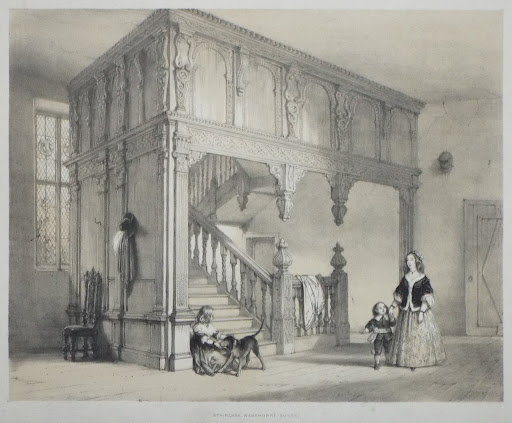
I stumbled down the staircase, each step causing the well-worn wood to thud below my feet. Reaching the central turn, I saw the lower floor stretching out in pitch darkness below.
The sound of footsteps above.
Shrinking back against the wall, I stared back up the stairs. At first, I could make out only a wide beam of moonlight filtering through the window at an angle. Then, from within the pool of light, the thin outline of a figure materialised, translucent yet undeniably real. It was dressed in robes and wore a coned hat—a mitre if my limited religious knowledge held correct.
I was beyond fear as I stared up at the apparition. What struck me more than anything was how the figure stared back down, frozen like a statue. On the man’s face—for a man it was, old and somehow unpleasant—was painted the definition of surprise. His mouth hung open, his wide eyes boring into mine with terror equal to my own.
To this day, I will never forget that sight: a phantom more scared of the living than the living fears the dead. It has led me to question many of the tales of ghostly encounters I have heard since. Mortals, it seems, must always be frightened of the dead—yet we never consider what it feels like to embody that lost connection between our world and what lies beyond. Fear, confusion, a sense of entrapment. It must be a terrible existence to be an apparition whose only purpose is to cling to the slowly fading past.
I was only half aware of my actions as my legs carried me down the remaining steps to the front door, where I found the handle locked tight.
‘No, no, no,’ I wailed. ‘Let me out. Please…’
My voice sounded strange and shrill to my ears. Leaning against the door, I tried to reassure myself.
All in your mind. Your affliction is doing this. It’s the effects of your imagination.
I headed toward the chapel and the hidden toilet I had discovered earlier that day, but I had not gone far when something came into view ahead. A black shape hovered at the end of the corridor, seeming to stoop over, shambling towards me.
I burst through the nearest door and found myself inside the chapel. Above my head, the moonlight shone through the saintly figures staring down in quiet judgement from their stained-glass windows. Ignoring them, I ran to the confessional and shut myself inside, taking care to close the red curtain behind me. It may have seemed foolish to try and escape from the unknown in that way, but there was little choice. I was beyond myself, like a child playing hide-and-seek.
My ears began to ring again in the dreaded silence.
Nothing.
Then, a noise that set my entire body trembling: the sound of feet approaching in soft measures, halting in front of me. Staring at the fabric, I dug my nails into my leg, waiting for it to open. Instead, I heard another sound—the curtain being pulled aside in the opposite compartment.
It—whatever it was—was sitting beside me, blocked off from sight by the latticed grill.
Bless me, father, for I have sinned.
I closed my eyes, stuffing my fingers inside my ears, but it was no use. The voice was soft and whispering—the voice of a young man.
Bless me, father, for I have sinned.
‘What do you want?’ I hissed. ‘Just leave me be!’
Bless me, father… forgive me.
‘Just tell me who you are.’
Denied love. Not permitted. Forgive me.
‘Were you a bishop?’
Bishop punished me. I was young. How can it be a sin?
‘What do you want from me?’
The steadiness of my voice surprised me. I decided it must be an auditory hallucination. I only had to play along for a while, and the attack would pass. From somewhere within my subconscious, my imagination was producing this otherworldly discourse. Or so I thought.
Free me. Release me. Release us. Where he put us. So dark.
‘Speak plainly.’
Below the fountain. Forgive me, father… I have sinned… forgive… forgive…
There was no more after that. One moment, I could sense the mysterious entity beside me; the next, it was gone—floating away like a cold breath. As I left the safety of my hiding place, I caught sight of several feathers hanging in the air. The torn and half-shredded pillow I had seen earlier inside the opposite compartment lay at my feet.
*
As I exited the chapel, my face was hit by a biting breeze that felt like it belonged more to the middle of winter than high summer. To my side, a small door lay ajar, as if the entity had deliberately gifted me a way out.
Making my way outside, I took a deep breath of the clean night air. I still felt oddly calm in the face of all my experiences. Before me stretched a long, straight path leading in the direction of the visitor’s centre, surrounded by perfectly maintained lawns like dark pools in the night.
I had almost reached the end of the path when something compelled me to look back. The house loomed tall, framed by the moon behind. It had seemed grand and appealing in the daylight, but in the darkness, the silhouette was more nightmarish than ever. The sharp, jagged edges and cruel lancet windows glared out like thin eyes, causing me to shudder and turn away, more determined than ever to escape.
Before me, a short flight of steps descended towards a wide, ornamental fountain. From the back of my memory, I recalled the wedding photos hanging on the board. Several of them had been taken beside it. Then I remembered something else.
Release us. Bishop punished me.
What was it the spirit had said? Something about being denied love—about it not being permitted?
Below the fountain… where he put us…
Us. But who was the other?
The water in the fountain had been drained away, marked by a sign informing visitors it was being renovated. I stepped over the edge. Somehow—as if the spirit was guiding my feet—I knew where to go.
The tiles were loose and came away with ease. Then, closing my eyes in fear of what I might discover, I dug my hands beneath the soft earth, clawing away at it until my hands touched a solid object.
Opening my eyes, I felt a solitary tear fall down my cheek. I watched as it landed softly on the ground below.
*
The following is an excerpt taken from Sussex Local News. It is dated two days after my discovery and two days after I fled the gardens in a temporary state of madness and denial.
The remains of two skeletons were discovered by the head gardener yesterday morning in Wakehurst Place, a popular local historical site. Both bodies appeared to have been accidentally unearthed by foxes or badgers during recent renovations. Early investigations indicate the two individuals were killed and buried over two centuries ago. The chief forensic officer revealed to our reporter that the fingers of the victims were cut off before their bodies were arranged side-by-side in a close embrace.
Several crucifixes were discovered beside the bodies, indicating the victims—both identified as male—likely belonged to the priesthood.
Thanks for reading. This short story was written as an ode to the likes of M.R. James, Angela Carter, and Sheridan Le Fanu. It was inspired by real features and locations at Wakehurst Place in Sussex. The story was previously published as part of a printed short story collection, “Suspense and Fright”. Read more here.
 AJ Comley